The Production Loop #11: The Evolution of Data Reconciliation: From Manual Checks to Autonomous Agents
Transforming Reconciliation from a Manual Chore into an Intelligent Process

Hey Data Leaders & Architects,
Reconciliation today is more than just matching numbers. Across finance, operations, and migrations, teams struggle with data mismatches, hidden rules, and endless manual checks. Traditional automation helps, but it often falls short. AI agents, on the other hand, don’t just check, they adapt, learn, and fix issues so your data stays accurate and trustworthy.
In this edition, we’ll explore how AI agents tackle reconciliation challenges, continuously validating data, adapting to changes, and preventing problems before they snowball.
The future isn’t rule-based scripts, it’s autonomous AI agents that reason, learn, and keep your data reliable.
Why Automation Alone Falls Short
Automation has been a lifesaver for reconciliation, running comparisons, syncing records, and generating reports.
But here’s the problem: automation only executes what it’s told.
It doesn’t understand context.
It doesn’t adapt when things change.
That’s why mismatches still slip through when:
Hidden business rules aren’t documented
Formats or schemas change unexpectedly
Subtle anomalies go undetected until they hit critical reports
Automation moves data. But it doesn’t protect trust.
How Agentic AI Transforms Reconciliation
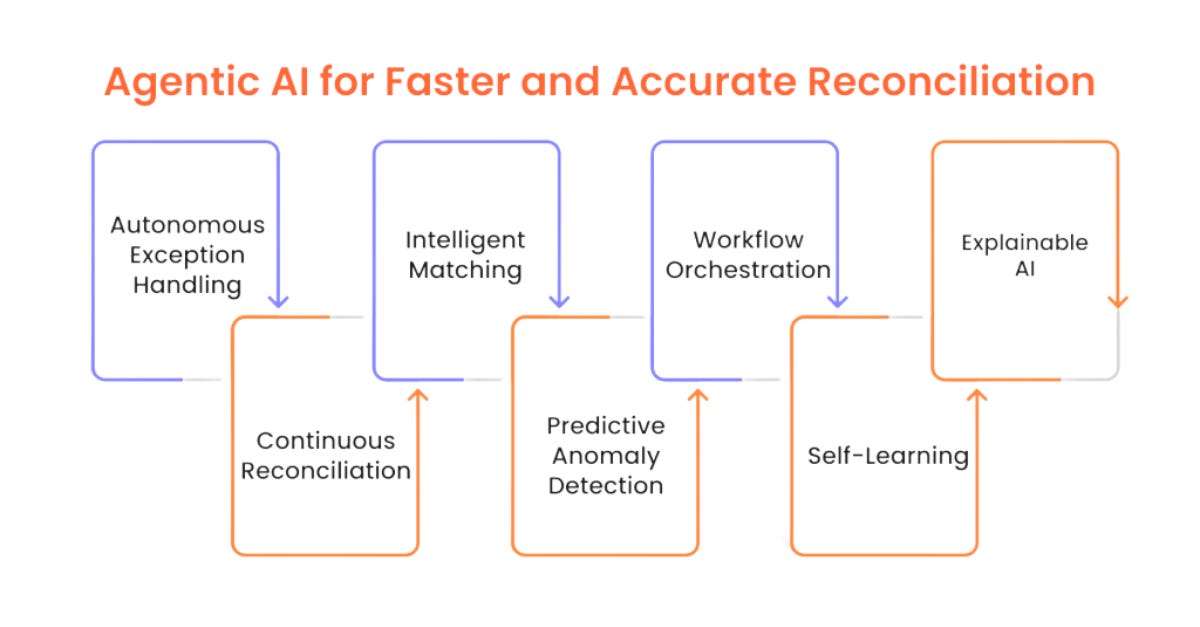
Unlike static tools, AI agents reason, adapt, and self-heal. Here’s what they bring to the table:
Contextual Intelligence
AI agents scan schemas, logs, and lineage to understand data context, without mapping every rule manually.
Smarter Validation
They validate values, joins, aggregates, and embedded business rules, not just row counts—catching issues before they reach production.
Self-Healing Checks
Instead of halting processes when a mismatch appears, agents suggest or apply fixes dynamically, keeping reconciliation predictable and reliable.
Tackling the Real Challenges
The toughest part of reconciliation isn’t running checks, it’s managing risk:
Skill shortages: AI reduces dependence on scarce domain experts
Time pressure: Intelligent orchestration accelerates validation
Data quality risks: Continuous checks catch broken rules early
Trust & compliance: Embedded monitoring protects sensitive data
Agentic AI addresses these challenges head-on, transforming reconciliation from a reactive task into a proactive capability.
Why It Matters Now
In today’s fast-paced data landscape, failure tolerance is lower than ever.
Dashboards going dark. Financial reports mismatching. Compliance gaps emerging post-go-live.
Static scripts and manual fixes just don’t cut it anymore.
With agentic AI, reconciliation becomes:
Faster
Safer
Less dependent on heroic manual effort
Key Takeaways
Reconciliation is a critical trust function, not just a check-box process
Automation alone can’t handle schema drift, hidden rules, or subtle anomalies
AI agents acquire context, validate continuously, and self-heal workflows
The result: predictable, repeatable processes that protect data integrity at scale
Your reconciliation isn’t just about matching numbers, it’s about maintaining trust. And trust breaks fast when something “looked fine” but wasn’t.
Let’s stop relying on static scripts and manual patches.
Let’s start building agentic systems that adapt as fast as our data does.
Seen a reconciliation project where automation wasn’t enough? Drop a comment and share your story; your experience might save someone else’s data integrity.
PS: If you found this valuable, share it with a colleague responsible for reconciliation. You might help them avoid the most common pitfalls and unlock the true potential of AI-driven reconciliation.